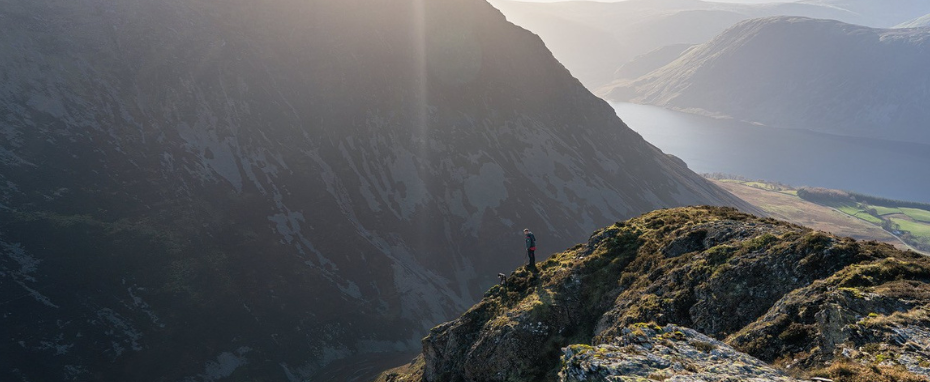
Future Fells: What next for the Lake District uplands?
15 Jan

Future Fells: What next for the Lake District uplands?

business
|
1h 50m
An expert panel including academics and land managers debate what the Lakeland Fells will look like in 5, 50 and 500 years in a wide-ranging discussion covering biodiversity, farming, leisure and the changing climate.


The fabric of the fells has been changing for millenia. Wooded dales and hillsides – abundant with flora and fauna – were cleared in prehistory, then steadily settled and enclosed. Post-War headage payments led to overgrazing, while the farming support pendulum of today is swinging back, with commons agreements now limiting sheep numbers, posing an existential challenge to hill farming. The latest chapter in the long history of contested land use focuses on nature recovery, with swathes of the Lake District entering landscape-scale nature recovery schemes that will change the character of the fells for generations. Moving beyond the divisive ‘culture ve nature’ debate that reduced land use discussions to a binary ‘farming vs trees’ choice, our expert panel – Upland author Ed Douglas, Restoring Hardknott Forest’s John Hodgson, Upland Ecologist John Holland and Director of Centre for National Parks and Protected Areas Lois Mansfield – will showcase a selection of Lakeland case studies, talking water, fire risk, nature, farming and people, as we paint a picture of what the fells will look like 5, 50 and 500 years from now. A Countrystride Live podcast event, hosted by David Felton.


Our panel:


Dr John Holland: An upland ecologist based at Scotland’s Rural College Hill & Mountain Research Centre near Crianlarich, John’s areas of academic interest include the impact of grazing on upland vegetation, the management of grasslands, upland biodiversity, precision livestock farming, and hill farm greenhouse gas emissions and carbon storage. An active bird surveyor and plant recorder, John has helped establish two community woodlands, and was a trustee of the Farm Woodland Forum for more than ten years, a charity which advances public education in all aspects of the science and practice of farming with trees.


Ed Douglas: Author of the 2026-released ‘Upland – The Strange History and Vital Future of Britain’s Mountains’, Ed is a prize-winning author on mountains whose books include ‘Himalaya: A Human History’, shortlisted for the Duff Cooper Prize and ‘Kinder Scout: The People's Mountain’. Ed won the Boardman Tasker Award for mountain literature in 2010, has been a climber for 45 years and was for a decade the editor of mountaineering’s oldest publication, ‘the Alpine Journal’. Ed’s first climb was up Skiddaw and he has spent many years exploring the Lakeland fells.


John Hodgson: John is the Project Officer for Restoring Hardknott Forest, a partnership between the University of Leeds and Forestry England, which has been working since 2003 to restore a 630-hectare former conifer plantation to native woodland and other habitats for the benefit of people, nature and climate. At the heart of one of Lakeland’s best-kept landscape recovery projects, John has spearheaded a collaborative partnership – alongside Forestry England and local farmers – that has seen previously clear-felled hillsides return to native woodland with engagement from a range of local communities, including West Coast schoolchildren.


Emeritus Professor Lois Mansfield: Professor of Upland Landscapes, Director of Centre for National Parks and Protected Areas and a Special Advisor to the Lake Distrist National Park Authority, Lois’ academic life has been dedicated to rural development, uplands and farming, with a particular focus on Cumbria. Author of ‘Managing Upland Resources: New Approaches for Rural Environments’, Lois has spent 30 years exploring upland agriculture and its relationships with other land users, with current research interests focussing on multiple capitals approaches to managing upland landscapes where agricultural systems are marginal in character.


The discussion – with contributions invited from the audience – will be hosted by David Felton, producer of the Countrystride podcast, award-winning Lakes-based publisher and co-author of Forty Fells.
This event is part of a programme of events in response to Forty Fells – a photography exhibition in our main art gallery at Rheged. It’s a collaboration between International Photography Award winner Tom McNally and Lakeland Book of the Year winner, David Felton as they set out to record conversations about change in the Lake District Mountains and record the ancient and modern stories both visually and through words. A follow on to the hugely successful Forty Farm Exhibition, Forty Fell is also accompanied by a new book.

The Forty Fells Exhibition (free) in our Gallery, will be open from 5-6.30pm for this event.

Two 40-minute sessions with a 20-minute interval.

Photograph courtesy of Tom McNally
Times
15 Jan